
Part 3: 🔥 Coming in HOT! California Zone 0 Rules: What Homeowners Need to Know

You may have started hearing about California Zone 0 Rules, California's evolving wildfire defensible-space requirements for the first five feet around a home.
If you live in San Diego County or another fire-prone area of California, you may be wondering: Does it apply to my home? What may need to change? And when does it take effect?
Here’s a simple breakdown.
🏠 What Is California's Zone Zero?
Under California's proposed statewide regulations, Zone Zero would be divided into two areas: a stricter Safety Zone immediately next to the home and a Low-Combustibility Zone extending to the five-foot boundary.
Here’s the interesting part: the Safety Zone isn't necessarily the same width around every home.
📏 Why Roof Eaves Matter Under California's Zone Zero Rules

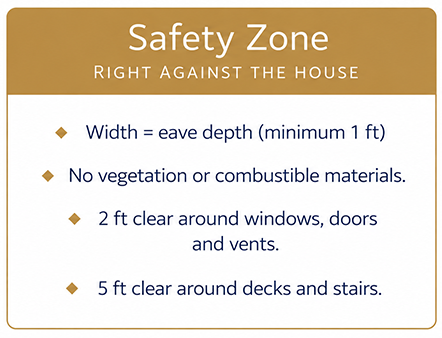
Under the proposed statewide regulations, roof-eave depth helps determine the width of the Safety Zone, with a minimum of one foot.
For example, a 6-inch eave would still require a 1-foot Safety Zone, while a 2-foot eave would generally mean a 2-foot Safety Zone. The remaining area, out to five feet, becomes the Low-Combustibility Zone.
Additional clearances are proposed around windows, doors, vents, attached decks and stairs, as shown below.
California's statewide Zone Zero regulations are still completing the final regulatory process, so these statewide standards remain subject to final publication.
🌿 What Can Stay in Zone Zero and What May Need to Change?
Here’s some good news: Zone Zero does not necessarily mean removing every plant within five feet of the house.
While the Safety Zone would allow no vegetation or combustible materials, certain small, maintained plants and noncombustible landscaping may be permitted in the Low-Combustibility Zone.
Other items that may need attention include mulch, firewood, dead vegetation, fencing, sheds, trees, and roof or gutter debris.
The key is what it is, where it is and how it is maintained.

⏰ California Zone 0 Rules: Tentative Timeline
There isn't one Zone Zero deadline for every California homeowner.
California's statewide regulations are still being finalized and propose phased compliance periods.
The City of San Diego already has its own Zone Zero requirements within Very High Fire Hazard Severity Zones, with requirements for new structures beginning in 2026 and existing structures phased through 2029.
Timing and requirements can vary by jurisdiction, so it’s important to check the rules where your property is located.


🔎 How Do I Know If This Applies to My Property?
Fire-hazard designations can vary from one property to another, even within the same community.
In a real estate transaction, the Natural Hazard Disclosure (NHD) report is an important tool for identifying fire-hazard designations affecting a specific property. I use SnapNHD for my Natural Hazard Disclosure reports.
If you're curious about your property, planning improvements, or thinking about buying or selling a home, feel free to reach out. I'm always happy to help point you in the right direction.
Helpful Resources:
Disclaimer: This content is provided for general educational and informational purposes only and is not intended as real estate, legal, or tax advice. Information shared is based in part on guidance and materials from C.A.R. Legal. Consult your broker, legal counsel, or other appropriate professionals regarding your specific situation.
CHRISTINE KUENEKE
Transaction Coordinator - DRE 01809365
Call or Text: 760-613-1626
ck@ckpremiertcservices.com

Comments